
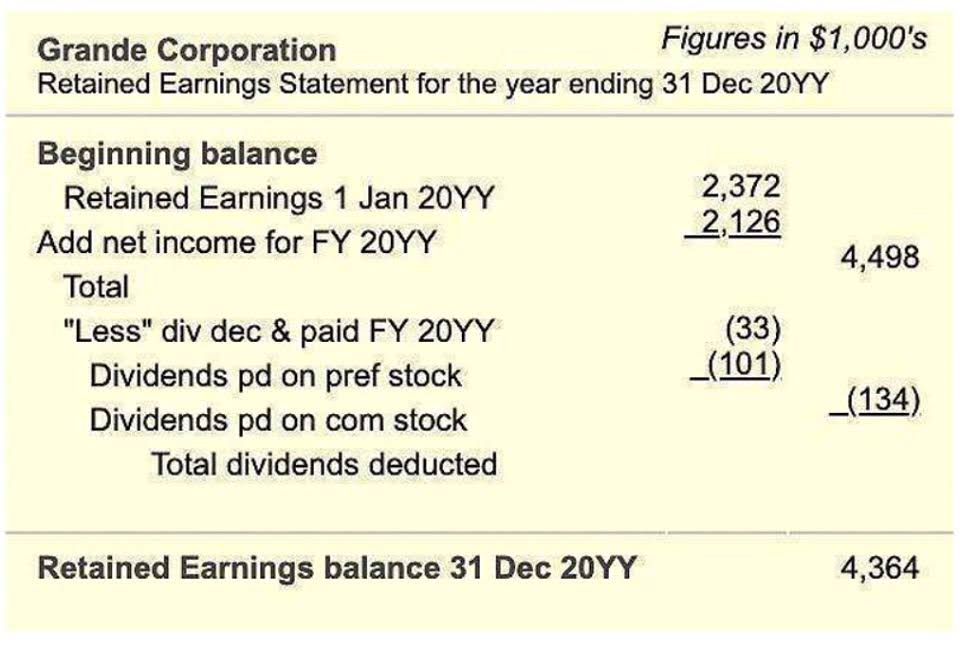
In this case, Company A paid out dividends worth $10,000, so we’ll subtract this amount from the total of Beginning Period Retained Earnings and Net Profit. Retained earnings can be less than zero during an accounting period — If dividend payments are greater than profits, or profits are negative. Retained earnings during a month, quarter, or year is the revenue the company collected beyond its expenses, which it did not distribute to owners. It is possible for a company not to raise enough revenues to cover its costs. In that case, the company operated at a net loss rather than a net profit for the accounting period. That loss, which is a negative profit, would translate to negative retained earnings.
- Retained earnings represent a useful link between the income statement and the balance sheet, as they are recorded under shareholders’ equity, which connects the two statements.
- Retained earnings appear on the company’s balance sheet, located under the shareholder equity (aka stockholders’ equity or owner equity) section.
- Now, you must remember that stock dividends do not result in the outflow of cash.
- The Retained Earnings account can be negative due to large, cumulative net losses.
- Your future will be marked by opportunities to invest money in the capital stock of a corporation.
Occasionally, accountants make other entries to the Retained Earnings account. Net income increases Retained Earnings, while net losses and dividends decrease Retained Earnings in any given year. Thus, the balance in Retained Earnings represents the corporation’s accumulated net income not distributed to stockholders.
Accumulated Deficits
Finally, there may be some accumulated gains or losses from parts of the business that don’t show up in the retained earnings account. If you had all of this other information, you could calculate a pretty good estimate of the retained earnings balance. For investors and financial analysts, retained earnings are essential since they offer in-depth insights into a company’s long-term growth potential. A company with a high level of retained earnings indicates that it has been able to generate consistent profits, which can be used for reinvestment in the business or to fund future growth opportunities.
Thus, at 100,000 shares, the market value per share was $20 ($2Million/100,000). However, after the stock dividend, the market value per share reduces to $18.18 ($2Million/110,000). Thus, stock dividends lead to the transfer of the amount https://accounting-services.net/the-ultimate-guide-to-bookkeeping-for-independent/ from the retained earnings account to the common stock account. Now, you must remember that stock dividends do not result in the outflow of cash. In fact, what the company gives to its shareholders is an increased number of shares.
Where to Find Retained Earnings in the Financial Statements
If retained earnings are low, it may be wiser to hold onto the funds and use them as a financial cushion in case of unforeseen expenses or cash flow issues rather than distributing them as dividends. However, if both the net profit and retained earnings are substantial, it may be time to consider investing in expanding the business with new equipment, facilities, or other growth opportunities. Retained Earnings are the portion of a business’s profits that are not given out as dividends to shareholders but instead reserved for reinvestment back into the business. These funds are normally used for working capital and fixed asset purchases or allotted for paying of debt obligations. Additionally, if a company retains too much of its earnings, it can lead to a decrease in shareholder dividends.
What is the purpose of retained earnings?
The statement of retained earnings is a key financial document that shows how much earnings a company has accumulated and kept in the company since inception. The numbers provide insight into a company's financial position and the owner's attitude toward reinvesting in and growing their business.
Additionally, investors may prefer to see larger dividends rather than significant annual increases to retained earnings. For an analyst, the absolute figure of retained earnings during a particular quarter or year may not provide any meaningful insight. Observing it over a period of time (for example, over five years) only indicates the trend of how much money a company is adding to retained earnings.
How to prepare a statement of retained earnings in 5 steps.
To calculate retained earnings add net income to or subtract any net losses from beginning retained earnings and subtracting any dividends paid to shareholders. Retained earnings can also be used to fund new investments or to pay dividends to shareholders. Companies can also use retained earnings to pay off Accounting Services and Bookkeeping Services Outsourced Expertise debt or to purchase new assets. In addition, retained earnings can be used to finance research and development projects, which can help a company stay competitive in the marketplace. Retained earnings are typically used to reinvest in the company, such as to purchase new equipment or expand operations.